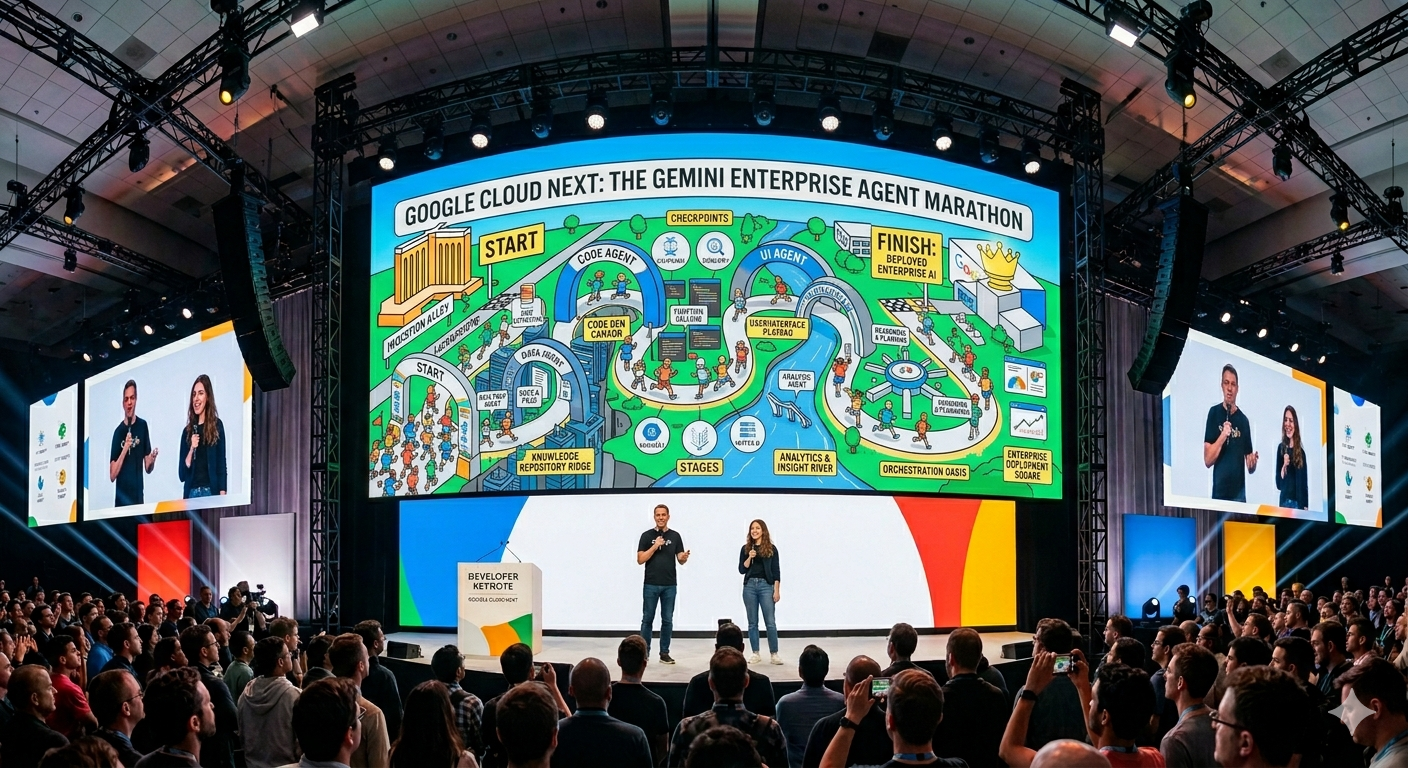
I said at the end of Day 1 that the second keynote might redeem things — that Day 1 felt like slow setup and Day 2 would be the payoff. I was half right. There were moments worth paying attention to. But the theme from yesterday continued. They introduced a lot of scaffolding, not a lot of structure to hang on it.
The Keynote
The theme was “Get Real: Agents in the Autonomous Era,” which is a good title if you’re optimistic and a bit ironic if you’re not. The format was a single extended demo building a multi-agent system to plan a marathon for 10,000 people through the Las Vegas Strip. Three agents: a planner to figure out routes, an evaluator to check them against community and business requirements, and a simulator to model the actual impact on the city.
The demo was well-constructed and the Codelabs they released alongside it are genuinely useful. But “plan a marathon” is a lot of setup for a metaphor that eventually maps to enterprise workflow automation. I sat there through most of it waiting for the part where it would connect to something I was actually trying to solve, and it mostly didn’t get there.
Day 1’s keynote was slow because it was laying out context. Day 2 was slow because the content itself didn’t have enough lift.
The Rebrand Nobody Asked For
The thing that felt like a nothing-burger was the announcement that Vertex AI is now the Gemini Enterprise Agent Platform. They’ve also absorbed Agentspace into it. One unified product, one name.
I understand the logic as someone that worked for a marketing company. Google wants to stop explaining to enterprise buyers why there’s a Vertex AI and a Gemini and an Agentspace and an ADK and an Agent Studio, and just say: here’s the platform, here’s what it does.
But “Gemini Enterprise Agent Platform” is four words of marketing wrapped around a product that practitioners already knew how to find. Vertex AI had brand with the developers actually using it. Renaming it doesn’t make the product better it just makes the documentation confusing for the next 18 months while everyone figures out which thing is which now. Also, the moving target of all the products still in preview or not yet released makes this offering feel less complete from my 100,000 ft view. I guess it might be better when I get in and start playing with it. I plan to review with our AI folks at CBH and see if I can get early access to play. Otherwise I might have to see what it will take to get it running in my own GCP instances.
Rebrands tend to signal that product positioning was unclear. This one confirmed it. I think we are likely looking at more rebrands or consolidations in the space. With AI models continuing to be a choice in these platforms I suspect we will continue to see rapid change as the industry evolves.
The One Genuinely Interesting Announcement
The most interesting thing in the keynote got about thirty seconds of airtime: A2UI, an open-source standard for automatically generating a user interface for your agent in a single shot. Build the agent, get a UI — the interface is derived from what the agent does, not designed separately from it.
That’s a different idea than most of what was announced this week. Everything else was about orchestration, governance, and runtime it is all the infrastructure around agents that many enterprises will need to allow them to adopt. A2UI is about what happens when an agent interacts with a user, and it treats interface generation as a first-class output. That’s worth watching. If it works at scale, it might accelerate adoption with a well built UI for the agents.
I find it funny that the one thing I felt was interesting was only a footnote in the presentation.
The Wiz Security Story
The Wiz integration got some coverage as a follow-up. The idea being that a “green agent” scans your agent code and infrastructure and can suggest root-cause remediations. It brings security based on what the agent built, not just what it’s running on or putting it in a walled garden. I’m still skeptical it’s production-ready, the demo felt rough. But the architecture feels right. If you’re going to govern agents, you need security tooling that can reason about agent behavior to build trust. We can’t just manage permissions and logs anymore.
The Pattern Repeating
The consistent theme across both days is that Google has assembled a “platform” out of a bunch of products. Right now it’s a collection of pieces that feel duct-taped together: ADK, MCP, Agent Runtime, Gemini Enterprise, Wiz, Codelabs. But, they could be the right foundation, it will be interesting how some of the other providers in this space look at this. The bet is that enterprises will choose the platform where the model, the runtime, the silicon, the governance, and the productivity suite all come from the same place. But, I don’t know how open this platform will be to allow integrations from third party players to make it better or fit better together.
But it only pays off if the whole thing works together in production, not just in keynote demos. And the honest read after two days is that a lot of it is still pre-GA, still preview, still “coming soon.” Google is describing a building that isn’t fully built yet, and doing it very professionally. The AI is there, but we are still missing the pieces to drive enterprise adoption. It reminds me of my iPhone 3. We were a BlackBerry shop. And no one thought that a consumer device would ever be trusted enough in the enterprise. Clearly we were all wrong… BlackBerry what? I have co-workers that don’t even know what that is. Everyone carries an iPhone or some alternative today.
I’ll keep watching, but I’m not waiting on the rebrand to tell me when it’s ready. I think we will see it phase in over time. For now, I think we will need to secure it the same way we did in the past, we will need to build secured use cases out for now, and enable a group of technically proficient and security minded early adopters.